B2B SaaS companies need a CMS that supports structured product and feature pages, ICP-specific landing pages, multi-locale content for global go-to-market, coordinated publishing across product launches, and more.
In this article, we explore 7 headless CMS platforms: Prismic, Contentful, Sanity, Strapi, Storyblok, Hygraph, and Kontent.ai, to see how they can fit your B2B SaaS content management requirements.
TL;DR (key takeaways)
- All 7 platforms covered in this guide offer strong foundations for B2B SaaS content management, and several go further with dedicated tools for AI-powered publishing, personalization, and governance.
- Prismic is best for SaaS marketing teams that need to scale SEO and ABM landing pages with AI, without relying on developer resources for every update.
- Contentful is best for enterprise B2B SaaS teams that need a deep integration marketplace, AI automation, and personalization across multiple surfaces.
- Sanity is best for engineering-led teams that want maximum content modeling flexibility, unlimited locales, and AI-powered content operations.
- Strapi is best for engineering teams that need full ownership and control over their CMS infrastructure through an open-source, self-hosted setup.
- Storyblok is best for marketing teams that need a live visual editor and the ability to publish pages independently without developer involvement.
- Hygraph is best for data-heavy SaaS products that need to pull content from multiple backend systems through a single GraphQL API.
- Kontent.ai is best for enterprise SaaS organizations that need AI-powered content governance, brand oversight, and multi-team workflow controls at scale.
What makes a CMS "B2B SaaS-ready"?
Every headless CMS platform can handle blogs and landing pages, so that’s not the bar for B2B SaaS.
A B2B SaaS marketing site is a different ballgame. You're managing:
- Feature pages for a product that ships updates every few weeks.
- Pricing pages that need to reflect packaging changes.
- Landing pages targeting five different ICPs with different messaging for each.
In addition, there’s a global expansion on the roadmap, and a growth team that needs to move fast
Your marketing team must execute all of this with minimal developer involvement, since most technical resources are focused on developing features, not updating content.
These are the elements that truly make a CMS ideal for B2B SaaS operations.
- It supports structured content for product pages. Feature pages, pricing tiers, integration directories, and use case pages all follow patterns. A good CMS lets you define those patterns once as content types and reuse them consistently.
- It can scale ICP-specific landing pages without proportional effort. B2B SaaS companies targeting multiple verticals, company sizes, or buyer personas need different messaging for each. Manually building a unique landing page for every combination is not realistic. The right CMS lets you generate those variations programmatically from a base template.
- It handles ABM at scale. Account-based marketing requires personalized landing pages for target accounts, and a CMS that supports account-specific page generation from data inputs is one that SaaS marketers would love.
- Its localization workflow goes beyond a locale toggle. Global GTM means publishing localized versions of your marketing site for different regions. The right CMS should support locale-specific editors, region-specific publishing permissions, and the ability to manage translation as part of the regular content workflow.
- It integrates with your marketing stack. Your CMS doesn't operate in isolation. It needs to talk to HubSpot, your analytics platform, your CDN, and whatever else your growth team runs on. Platforms with native integrations or well-documented APIs save your engineering team from building and maintaining custom code.
Check out our headless CMS guides
Explore our headless CMS guides, which cover the subject matter in detail.
| Platform | Best for | Key strengths | Pricing |
|---|---|---|---|
| Prismic | SaaS marketing teams running AI-powered ABM and SEO campaigns at scale | AI SEO and ABM landing page builders, Slice Machine, localization | From $10/month |
| Contentful | Enterprise B2B SaaS teams needing multi-surface content delivery and deep integrations | 130+ marketplace integrations, AI Actions, Personalization, localization | From €300/month |
| Sanity | Engineering-led teams wanting maximum content modeling flexibility | Content Agent, unlimited locales, plugin ecosystem | From $15/seat/month |
| Strapi | Engineering teams needing full ownership through open-source self-hosted setup | Plugin marketplace, open-source, AI capabilities, data residency control | From $45/month |
| Storyblok | Marketing teams needing a live visual editor and publishing independence | Live visual editor, AI SEO app, releases, 40+ integrations | From €90.75/month |
| Hygraph | Data-heavy SaaS products needing multi-backend content federation | Content Federation, GraphQL API, AI Agents | From $199/month |
| Kontent.ai | Enterprise SaaS organizations needing AI-powered governance at scale | AI agents, SEO/GEO audits, persona-specific content generation, localization | Available on request |
Best Headless CMS for B2B SaaS Businesses
1. Prismic
Best for: SaaS marketing teams running AI-powered ABM and SEO campaigns at scale
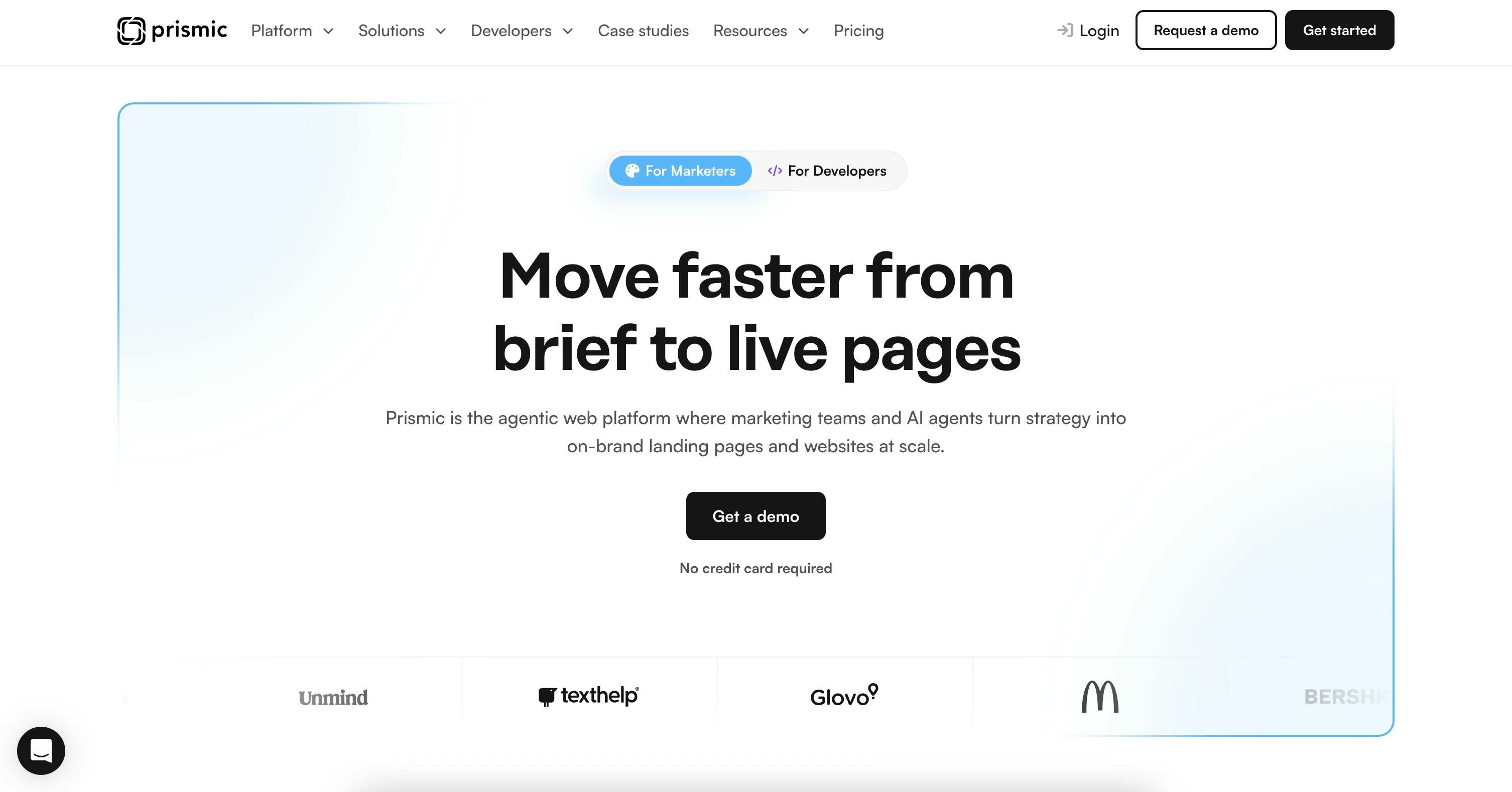
Prismic is a headless website builder built specifically for websites running on Next.js, Nuxt, and SvelteKit. It provides developers with a local development tool, Slice Machine, to build reusable page sections, and marketing teams with a visual Page Builder for assembling those sections into pages.
This split is important for B2B SaaS because it means the engineering team defines the brand-safe building blocks once, and the growth team can use them to ship feature pages, pricing variants, and campaign landing pages without having to file tickets.
B2B SaaS-specific strengths
- Prismic has two AI landing page builders that are designed to address the two biggest content-scaling challenges in B2B SaaS: SEO and ABM.
- The SEO landing page builder generates hundreds of optimized, on-brand landing pages from a single base page and a CSV of keywords. It's a major time-saver for SaaS companies targeting long-tail queries across multiple use cases or industries.
- The ABM landing page builder works the same way, but with account data. Upload a CSV of target accounts, and Prismic's AI agent generates personalized landing page variations with messaging tailored to each account's profile. This is the kind of capability B2B growth teams have typically built custom tooling for.
- Prismic Slices are reusable page sections, and each one can have multiple variations. A "feature highlight" slice might have a version with an image on the left, one with a video, and one with a stats block. It helps SaaS companies create unique pages while avoiding brand drift.
- Prismic Releases, a grouped publishing feature, lets teams prepare multiple content changes and simultaneously publish them on a schedule. With it, nothing goes live out of order, and no one has to log in at midnight to hit “Publish.”
- Prismic's localization lets you duplicate pages to a new locale individually or in bulk, toggle between locales directly from the page you're editing, and use AI-assisted translation to speed up the process.
- Prismic's Migration API handles large-scale content migrations—relevant for SaaS companies inheriting legacy content or consolidating sites after an acquisition.
Limitations for B2B SaaS
- The Page Builder's flexibility depends entirely on the slice library. If marketing needs a net-new section design, a developer must first build it into the Slice Machine.
- Prismic is a website-focused platform and doesn’t handle omnichannel content delivery to things like mobile apps and kiosks.
- Locales are capped per plan, and you’d get the higher subscriptions to access more locales. This factor is especially important for SaaS companies focused on major global expansion.
- Prismic doesn't have a built-in integrations marketplace, so there’s no one-click process for connecting third-party tools. That said, developers can use the Integration Field to connect any external data source to your repository by pulling from an API endpoint or pushing data directly to Prismic.
Pricing
- Free
- Starter ($10/month)
- Small ($25/month)
- Medium ($150/month)
- Platinum ($675/month)
- Enterprise (Custom)
Resources
2. Contentful
Best for: enterprise B2B SaaS teams
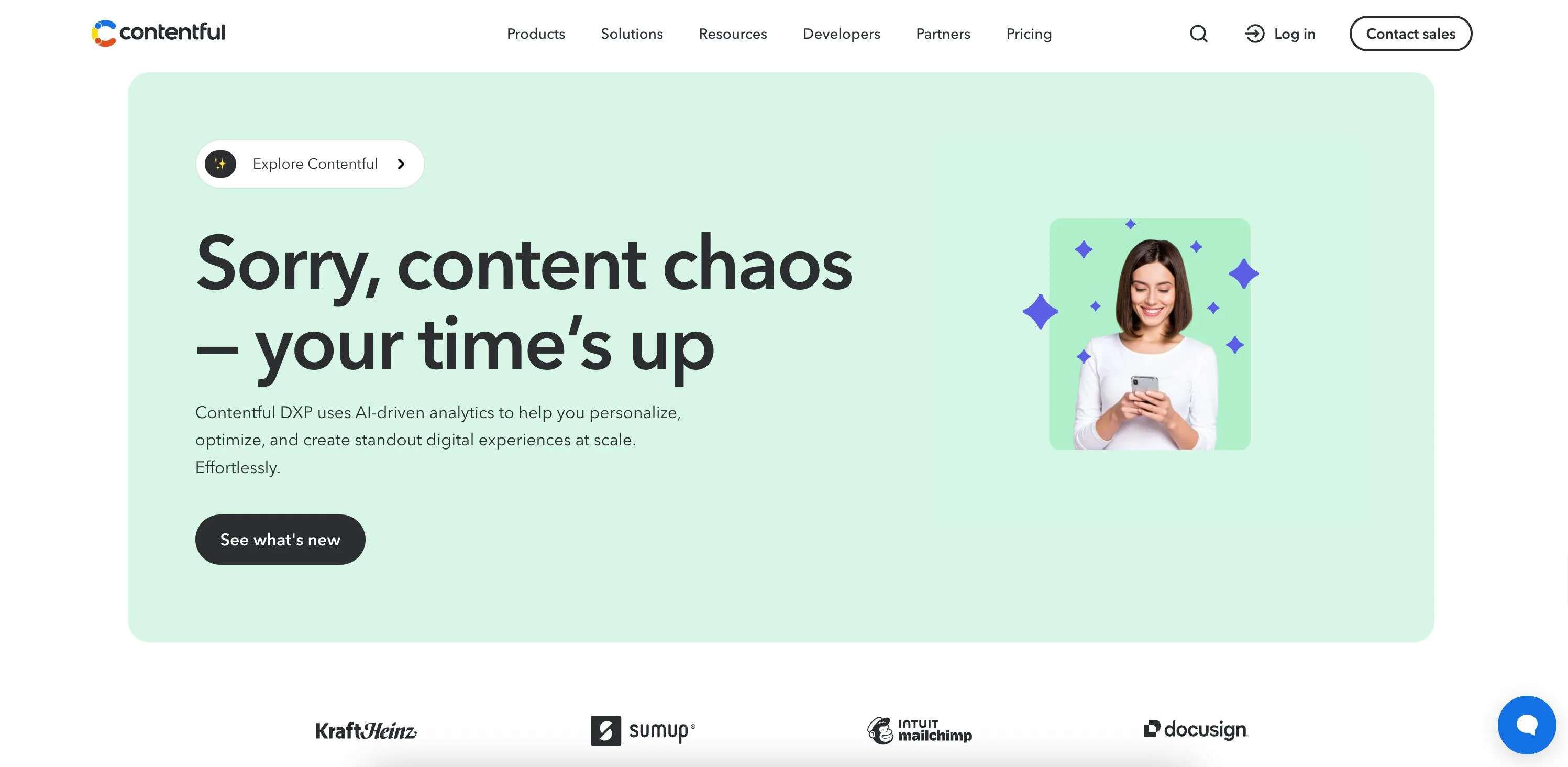
Contentful is an API-first content platform favored by enterprises for managing and delivering structured content across websites, mobile apps, and other interfaces.
B2B SaaS-specific strengths
- Contentful Personalization, which connects to CRMs and marketing platforms for audience data, lets marketing teams create audience segments, run A/B tests, and deliver personalized content experiences without developer involvement.
- Contentful's AI Actions, a built-in automation layer, lets you run AI-powered tasks across hundreds of content entries at once, including SEO metadata generation, grammar checks, and brand terminology enforcement, all with approvals and permissions built in before anything goes live.
- Contentful's localization is built directly into the editorial workflow, so teams can translate and publish content without exporting files or copy-pasting between tools.
- Contentful's Marketplace includes 130+ integrations covering marketing automation, ecommerce, DAM, analytics, A/B testing, and localization.
Limitations for B2B SaaS
- With prices starting at €300/month, Contentful is an expensive platform to use.
- Salesforce has signed a definitive agreement to acquire Contentful, and the transaction is expected to close in Q3 of Salesforce's fiscal year 2027. This is something to consider before making multi-year platform decisions, as it could affect Contentful's product roadmap and pricing structure post-acquisition.
- Contentful is primarily built for enterprise teams and may not be the right fit for early-stage or mid-market SaaS companies with lean budgets.
Pricing
- Free
- Lite ($300/month)
- Premium (custom pricing)
Resources
3. Sanity
Best for: teams that want agentic capabilities, content modeling flexibility, and unlimited locales
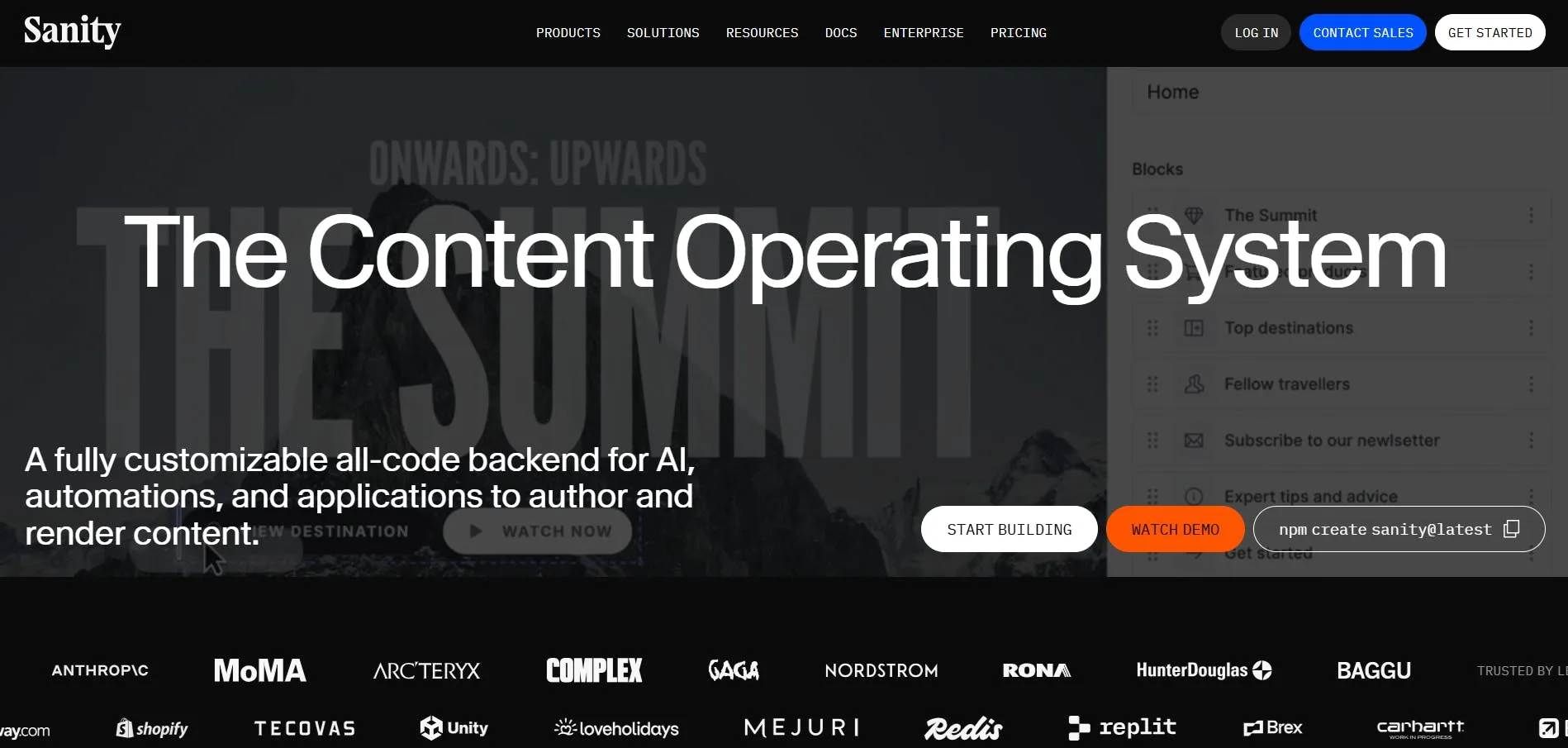
Sanity is a structured content platform built around the idea that content is data. Its editorial interface, Sanity Studio, is a fully customizable React application that development teams configure to fit their team's exact workflow.
B2B SaaS-specific strengths
- The platform’s Content Agent lets editorial teams run bulk updates, content audits, and gap analysis through conversation.
- The Content Agent API lets developers embed the agent directly in any pipeline or CI/CD workflow via code, enabling teams to build custom content automation tools that read and write Sanity content through natural language.
- All plans include unlimited locales, a major cost-saver for SaaS companies pursuing aggressive international expansion.
- Sanity’s Content Releases feature bundles multiple content changes across a project and lets teams preview them together or publish everything at once on schedule or on demand. And if something goes wrong after publishing, you can revert a release to restore the previous state.
- Sanity's plugin ecosystem includes official and community-built integrations for video management via Mux, advanced asset management, color inputs, markdown, map inputs, and more.
Limitations for B2B SaaS
- Sanity Studio is not an out-of-the-box editorial experience, which means developers must configure it in code before your content team can use it.
- Sanity's drag-and-drop functionality is limited to its Presentation tool, where editors can reorder existing content sections, and isn't available as a standalone page builder for assembling pages.
Pricing
- Free
- Growth ($15/month/per seat)
- Enterprise (custom)
Resources
4. Strapi
Best for: engineering teams that need full ownership and control over their CMS infrastructure through an open-source, self-hosted setup
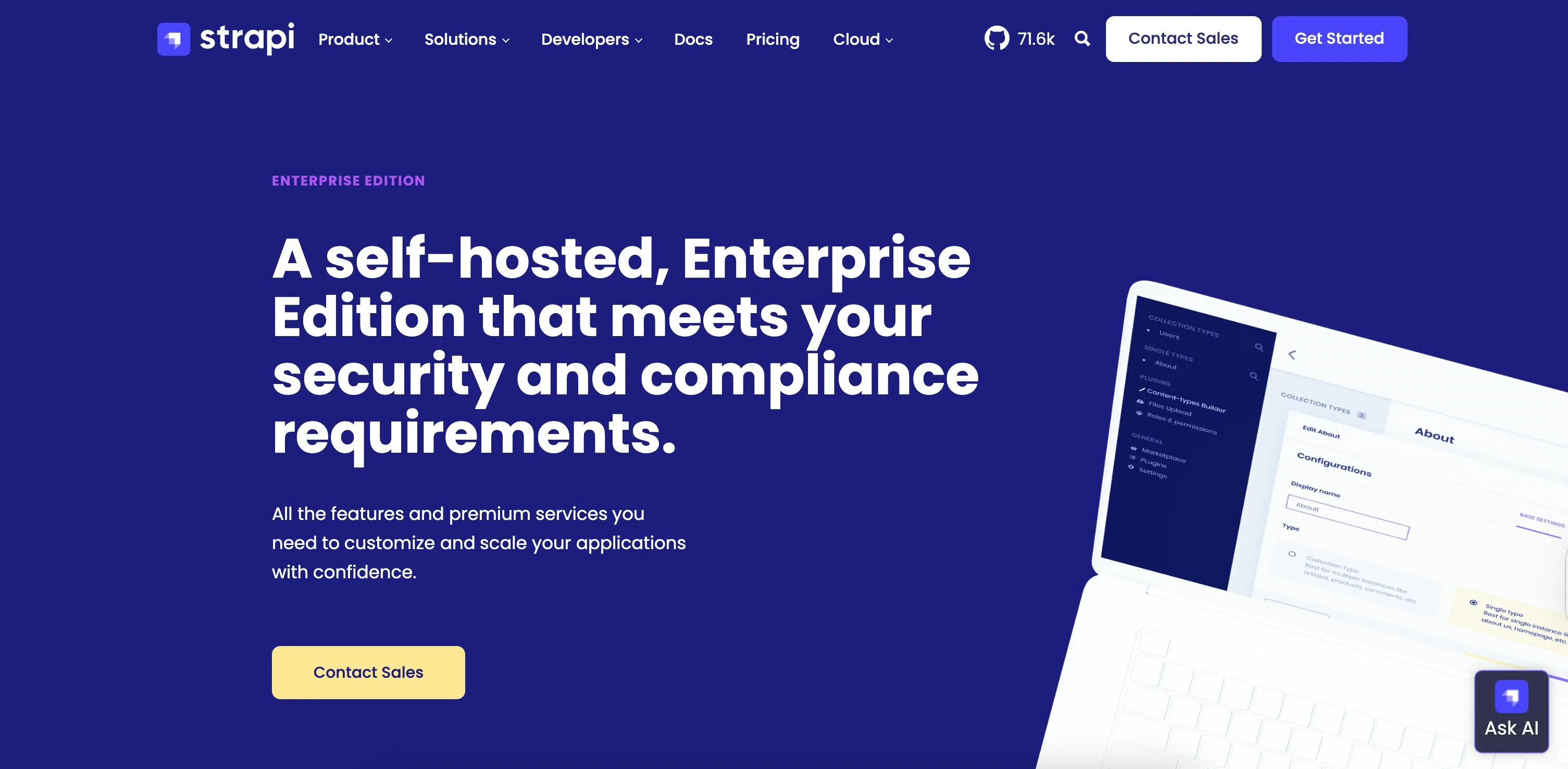
Strapi is the leading open-source headless CMS. It runs on Node.js, ships both a REST API and a GraphQL API out of the box, and can be self-hosted on any infrastructure or deployed to Strapi Cloud.
B2B SaaS-specific strengths
- Strapi's plugin marketplace contains hundreds of community and official plugins, including ones for SEO, image optimization, internationalization, monitoring, and email marketing.
- Strapi's open-source model makes it a great fit for SaaS companies with strict data residency requirements because their engineering teams would have complete control over the CMS codebase.
- The platform’s AI capabilities include an AI Content Type Builder for generating and refining content models via a chat interface, an AI Media Library that automatically generates alt text, captions, and tags for images, and AI-powered translations across all locales when the source is updated.
Limitations for B2B SaaS
- If you’re self-hosting Strapi, you’d have to bear the infrastructure costs.
- Strapi's admin panel is an editorial form interface, not a drag-and-drop page builder. Marketing teams that need to independently assemble landing pages from components will need a custom visual editing layer.
Pricing
- Community (Free)
- Growth ($45/month)
- Enterprise (Custom)
Resources
5. Storyblok
Best for: marketing teams that need a live visual editor
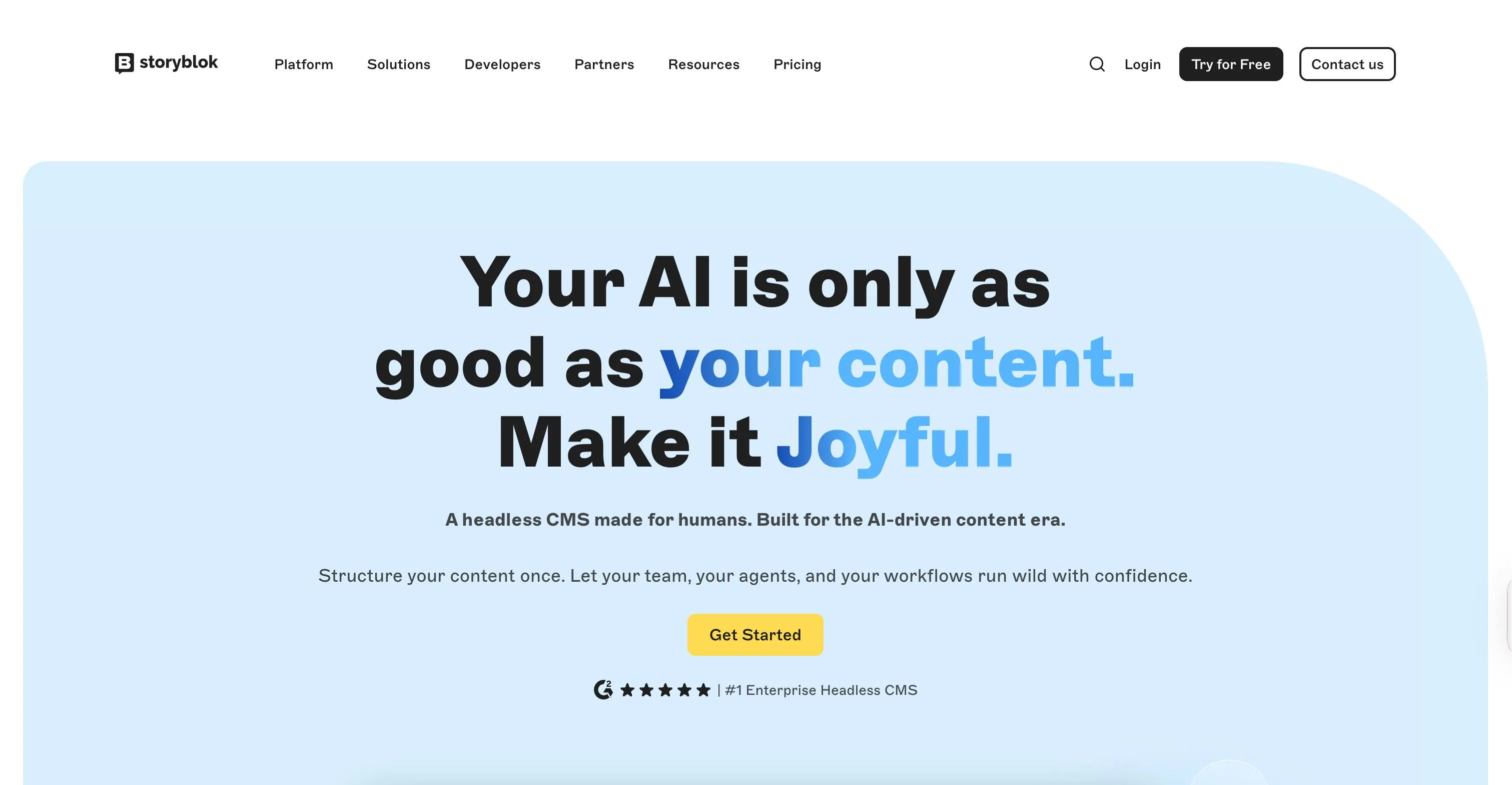
Storyblok is a headless CMS that puts a live visual editor at the center of the editorial experience. Content editors can click directly on page elements to make edits and see changes in real time while also publishing.
B2B SaaS-specific strengths
- The live visual editor lets editors click directly on page elements to make changes and see them reflected in real time, exactly as they will appear on the published page.
- Storyblok's AI SEO app, available from the App Directory, lets editors automatically generate SEO metadata for pages with a single click, which is key for SaaS teams managing large volumes of landing pages.
- The platform lets teams group and schedule content changes into releases for coordinated publishing.
- Storyblok's technology ecosystem includes 40+ integrations across ecommerce, DAM, search, localization, and commerce platforms.
Limitations for B2B SaaS
- Storyblok offers both GraphQL and REST APIs, but the GraphQL version is only available on the enterprise tier (Premium and Elite).
- Similarly, the AI SEO plugin can only be accessed by getting their enterprise plan.
Pricing
- Starter (Free)
- Growth (€90.75/mo)
- Growth Plus (€319.91/mo)
- Premium & Elite (Custom)
Resources
6. Hygraph
Best for: data-heavy SaaS products that need to pull content from multiple backend systems through a single GraphQL API
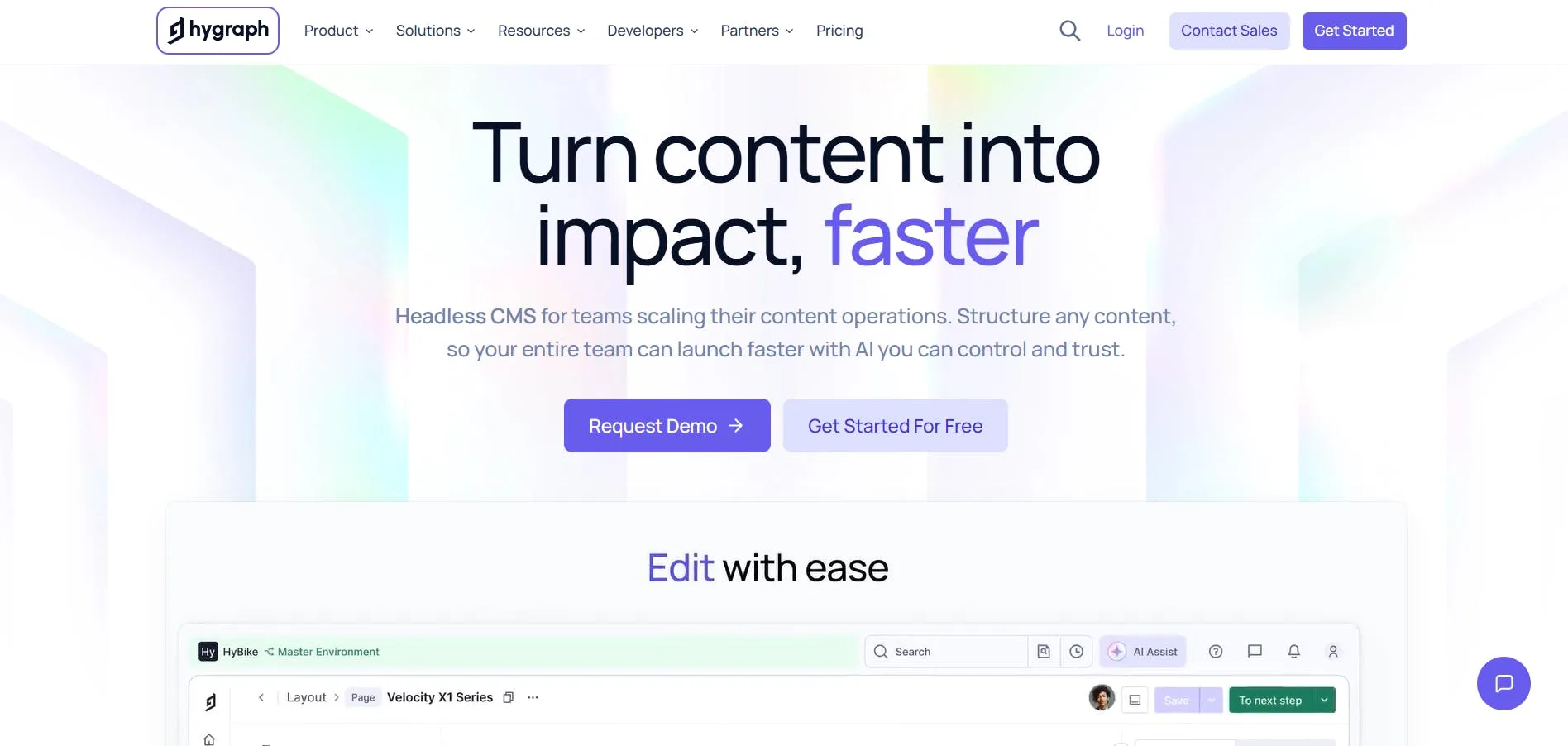
Hygraph is a GraphQL-native headless CMS with a capability called Content Federation that lets teams pull content from external REST or GraphQL sources directly into the Hygraph content model and expose it all through a single API endpoint.
B2B SaaS-specific strengths
- Hygraph's Content Federation lets you bring data from any REST or GraphQL API directly into your content model, meaning you don't have to migrate or duplicate data from your CRM or product catalog just to query it alongside your website content.
- Hygraph's GraphQL API is natively typed and mirrors the content structure exactly. Developers who are new to GraphQL can build frontend queries that are self-documenting because the schema reflects the content model directly.
- Hygraph lets you create isolated project environments to test schema changes and new content types without touching production. This lets SaaS engineering teams that iterate on content models frequently evolve their schema safely before going live with any changes.
- Hygraph's AI Agents automate repetitive content tasks directly within workflows, including translations, SEO checks, and content summaries, with human approval built in before anything publishes.
Limitations for B2B SaaS
- Hygraph is built entirely around GraphQL, which can be an issue for engineering teams and development processes that are focused on REST APIs.
Pricing
- Hobby (Free)
- Growth ($199/month)
- Enterprise (Custom)
Resources
7. Kontent.ai
Best for: enterprise SaaS organizations that need AI-powered content governance and oversight at scale
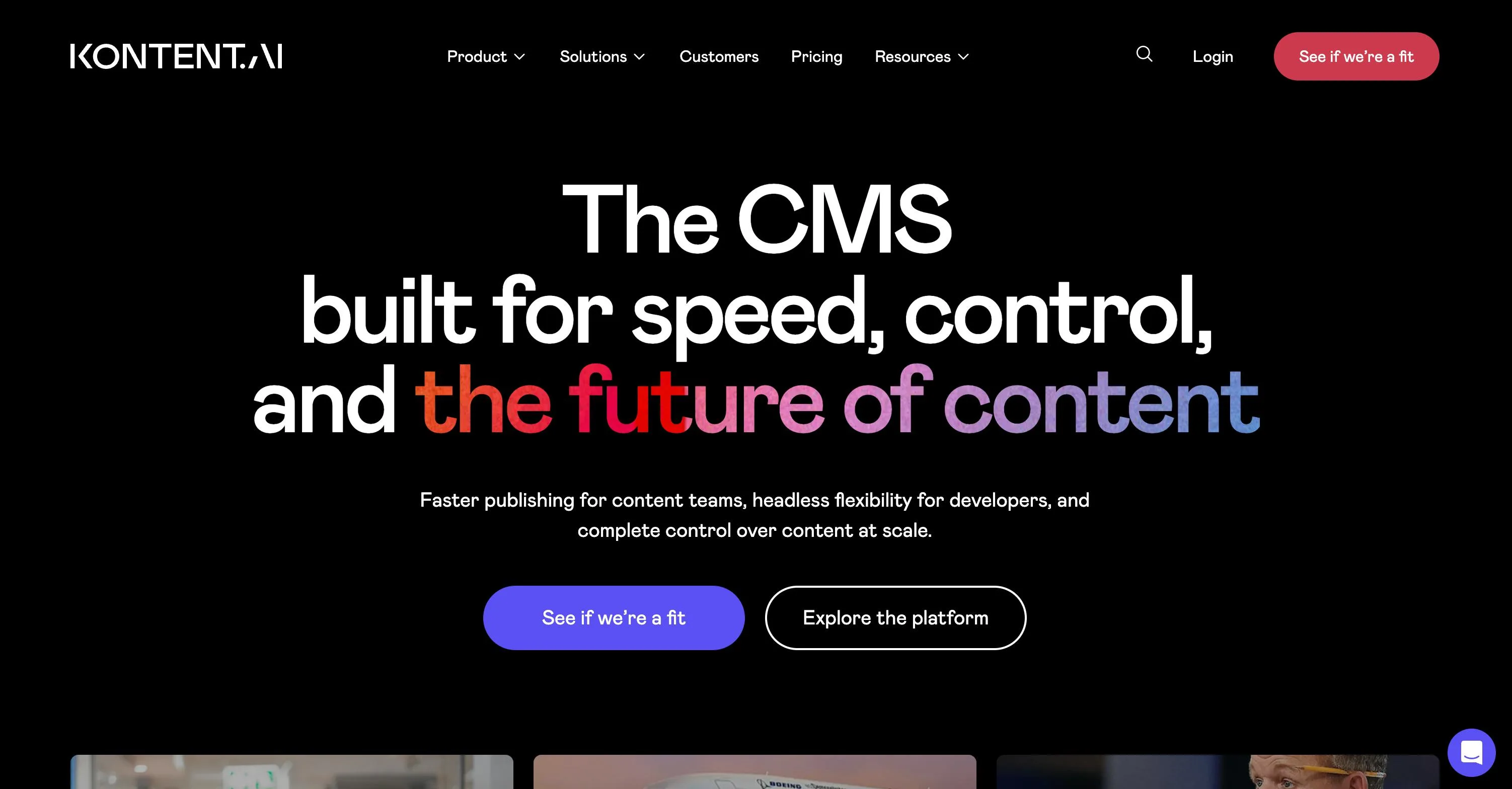
Kontent.ai positions itself as an "Agentic CMS" built around speed, governance, and developer flexibility. AI agents handle repetitive work, freeing content teams to focus on creative and strategic activities.
Developers get open APIs that let them query and deliver content to any frontend or channel, and the freedom to build their tech stack with whatever tools and frameworks they prefer.
B2B SaaS-specific strengths
- Kontent.ai’s AI agents automatically audit your entire content inventory for SEO and GEO gaps, then recommend and apply fixes at scale.
- The platform’s AI agents automatically generate full content variants for different personas, adjusting tone, narrative framing, and messaging to match each segment without manual rewriting.
- Kontent.ai’s localization is built around structured content models that separate global and local variants, with AI agents running in the background to flag outdated or incomplete localized versions whenever the source content changes.
Limitations for B2B SaaS
- Pricing is not publicly listed.
Pricing
- Available on request
Resources
How Headless CMS helps SaaS teams ship faster
Without a headless CMS, your marketing and content team is stuck in a loop. Need a new landing page? File a ticket and wait for engineering. Want to update the homepage hero before a product launch? Hope it makes the next sprint.
Every content change that touches the frontend becomes a dependency that joins a things-to-do backlog—maybe in the next quarter if it's urgent enough.
A headless CMS breaks SaaS teams out of that loop by enabling them to:
- Publish independently once developers build out the reusable page components.
- Keep content on-brand because everyone works from the same pre-built components and structured content types, regardless of who hits publish.
- Reuse content across channels so the same piece of content reaches your audience.
- Coordinate product launches more easily by grouping content changes across multiple pages and publishing everything at once.
- Scale SEO coverage without hiring more people by generating hundreds of optimized landing pages from a single template.
Recap and next steps:
In this article, we explored seven headless CMS platforms for B2B SaaS: Prismic, Contentful, Sanity, Storyblok, Hygraph, Kontent.ai, and Strapi. Each one approaches content management differently, and the right choice depends on your SaaS team's needs and workflows.
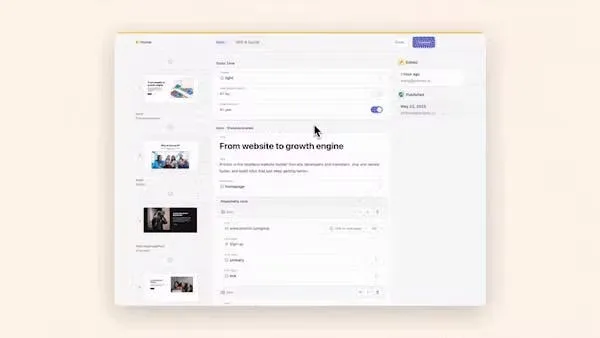
If you need a headless CMS that lets your marketing team publish pages, scale SEO landing pages, and run ABM campaigns without filing engineering tickets, consider Prismic.
You can get started with Prismic for free, explore the platform at your own pace, or book a demo with our product experts for a more guided experience.
FAQs
What is the best headless CMS for B2B SaaS in 2026?
No headless CMS is the best; it depends on your team's priorities. Having said that, here are some great options to consider.
-
Prismic is best for SaaS marketing teams running AI-powered ABM and SEO campaigns at scale.
-
Contentful is best for enterprise teams that need multi-surface content delivery, a deep integration marketplace, and AI-powered personalization and automation.
-
Sanity is best for engineering-led teams that want maximum content modeling flexibility and unlimited locales.
-
Strapi is best for engineering teams that need full ownership and control over their CMS infrastructure through an open-source, self-hosted setup.
-
Storyblok is best for marketing teams that need a live visual editor and the ability to publish pages without developer involvement.
-
Hygraph is best for data-heavy SaaS products that need to pull content from multiple backend systems through a single GraphQL API.
-
Kontent.ai is best for enterprise SaaS organizations that need AI-powered content governance and oversight at scale.
Can a headless CMS manage product documentation?
Yes, a headless CMS can manage product documentation because it stores content as structured data and delivers it through an API. You model your docs the same way you model any other type of content.
That means your documentation can live in the same CMS as your marketing site and get pulled by a separate frontend, or fed into a dedicated docs portal. Non-technical team members can update content without touching code, and everything stays consistent because it's all coming from one source.
That said, a headless CMS is not the same as a purpose-built documentation tool. If your docs are highly technical with complex versioning or heavy cross-referencing, a dedicated docs platform may serve you better. But for most B2B SaaS companies managing product docs alongside marketing content, a headless CMS gets the job done.
How does headless CMS support B2B content personalization?
Headless CMS solutions support B2B content personalization in different ways depending on the platform.
-
Prismic handles personalization through its ABM landing page builder, which lets you generate hundreds of account-specific page variations from a single template so each target account gets messaging tailored to their profile.
-
Contentful’s personalization solution lets marketing teams create dynamic audience segments, run A/B tests, and more without a developer being needed.
-
Sanity supports personalization through its official personalization plugin, which lets you run A/B/n tests at the field level and create audience-based content variants.
-
Storyblok’s component architecture lets teams create and manage content variants for different audiences. Users can also connect external personalization tools like the VWO plugin.
-
Hygraph has a native Variants feature that lets you create multiple versions of a content entry targeted to different audience segments without duplicating your content.
-
**Kontent.a**i handles personalization by letting you create multiple versions of your content and tag them with metadata that identifies which audience they are meant for.
-
Strapi handles personalization through integrations with third-party tools. You store your content variants in Strapi and connect an external experimentation platform to handle targeting logic, A/B testing, and user segmentation.
Which headless CMS integrates with HubSpot?
All seven platforms can connect to HubSpot in some way, but the depth of that integration varies quite a bit.
-
Prismic supports embedding HubSpot forms as a Slice in your Next.js project through a developer-built setup. There’s a tutorial about this on the Prismic blog.
-
Contentful has a HubSpot app in its Marketplace that maps Contentful entry fields to custom HubSpot email modules and syncs content automatically whenever changes are made in Contentful.
-
Sanity supports HubSpot form integration through its @sanity/form-toolkit plugin.
-
Storyblok connects to HubSpot through FlowMotion, its enterprise automation layer, which can trigger HubSpot campaign actions whenever a content event fires in Storyblok.
-
Strapi connects to HubSpot via REST APIs and webhooks. Developers map Strapi content types to HubSpot objects, and webhooks automatically trigger HubSpot workflows when content changes. This integration isn’t officially supported by the Stapi team, and they won’t provide assistance with it.